|
|

|
PLATFORM
|
DS
|
BATTLE SYSTEM
|

|
INTERACTION
|
|
ORIGINALITY
|

|
STORY
|
|
MUSIC & SOUND
|
|
VISUALS
|
|
CHALLENGE
|
Hard
|
LANGUAGE BARRIER
|
High
|
COMPLETION TIME
|
20-40 Hours
|
|
OVERALL

|
+ Does the JRPG thing very well
+ Good use of in-battle gimmicks
+ High-quality sprite graphics
+ Good voice acting
- Nasty difficulty spike at the end
|
Click here for scoring definitions
|
|
|
Once upon a DS, there was a magical world called Luneheim. The creation of a trio of divine sisters, it was en route to a head-on collision with a neighboring planet. Through great feats of magic, the goddesses managed to merge the two worlds, creating in the process three moons which served as both their demesnes and as habitats for their respective servant races. On Luneheim, the native humans and the newly arrived skyfolk shared an uneasy existence, with tensions rising over the centuries until two mighty nations coalesced along a dividing line of tolerance and discrimination. Summoning servants of the three goddesses from their moons, the Empire fought the Kingdom in the great Summons War, and not even the goddesses escaped its conclusion unscathed.
That's all in the past, however, as Summon Night X: Tears Crown starts a few years after the ceasefire is called. Emperor Grouen and King Nordis have agreed to an exchange of hostages in the classical fashion, each sending their own son to the other's capital in order to study and learn. This works out about as well as anyone might expect, and the story that follows is gloriously classic in its JRPG presentation. Instead of staying generic or attempting a cynical and self-aware deconstruction of its genre, Summon Night X embraces all the things that have made older games such nostalgia-fests, and its treatment of the main cast works well in its favor. In many ways, it feels similar to Lunar or the SNES Final Fantasy titles, which is usually a good sign.
Several decisions have some impact on how the player sees the story. First, there is the choice between two protagonists: Prince Dylan of the Empire or Princess Fara of the Kingdom. There are perhaps half a dozen points in the game's twenty-one chapters where the plot diverges for a short while, with Dylan going one way and Fara another. This state of affairs generally doesn't last long, as the game really has just the single unified plotline, but it's a nice change of pace. The other decisions come at the end of each chapter, when the player chooses one party member to chat with about the events of the day. The reactions of the various characters are always memorable, and provide much-needed insights into their personalities and backgrounds. It also raises the levels of camaraderie between them and the protagonist, which eventually unlocks powerful co-operative abilities in battle.
The battle system makes excellent use of the dual screens, with combat taking place both on the ground and in the air. Many spells and skills can target groups on either screen at a time, and a few are specifically limited to just one. Three of the party members can fly and two others have projectile weapons, while the ground-based melee characters have different methods of attack depending on where the target is. For example, a whip-wielding character can normally hit everything on the lower screen, but only one airborne enemy at a time (with a thrown book). Many additive effects on melee weapons, like status effects or pickpocketing, lose their power between the two screens, so there's a lot to consider when strategizing and optimizing equipment for the big fights.
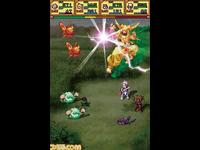 Electrified boot to the head! |
|
Also on the field of battle are the gimmicks, items that react in various ways when hit. They could be interesting and dangerous varieties of plants, just waiting to be watered by a magic spell. They could be electrified barriers that turn on and off every few turns, or floating mines, or unstable ordnance. There are a couple dozen sorts of gimmick in the game, and figuring out their various ways can make many battles much easier to get through. For added fun, some fights (and most boss battles) have attached "feats of bravery" which stand as secondary objectives or challenges. Many of these feats are impossible, or at least very difficult, without taking gimmicks into account. The rewards for meeting these objectives are often quite nice as well.
The biggest part of the entire system is the Summons Plates. Those bits of mystic technology are holdovers from the Summons War, and will each summon a distinct entity from one of Luneheim's three moons. Depending on its origin, the plate requires either white, gold, or black mana stones of varying amounts in order to activate, though thankfully these can often be found in convenient treasure boxes not far from where the plates are found, or received as spoils post-battle. The summoned creatures provide the majority of the game's character customization, as they often provide specific elemental or status bonuses, additive traits like pickpocketing or life drain, and of course all of the magic spells in the game. A summoned creature learns new abilities according to how many battles it's been carried into, so it's not hard to level them up in the course of the usual game progression.
What's harder to level up are the abilities provided by the summons. In addition to white, gold, and black, there are red mana stones which can be used to augment skills. Each summons plate has a set number of slots for red stones, and the player will need to make some hard decisions over which skills to optimize, because maxing out one single skill most likely will block any advancement for its neighbor on the summons plate. Sometimes the choice is easy, like deciding between a minor power boost on an attack or a five percent increase in elemental defense. Summon Night X is too frugal in its distribution of red mana stones, so it's very unlikely that every slot on every plate will be filled, but if the player has any regrets, then as a last resort colorless mana stones will undo any augmentations. Odds are, the player will have far more stones of every color but red by the end of the game, however.
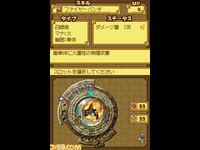 Oh, how I wish the game gave you that much red mana. |
|
As an interesting aside, about halfway through the game bonus quests become available. These follow a parliamentary procedure, of all things. The main character chooses three members of the party (besides Dylan or Fara) to be the ministers for the parliament, and it is these people who bring new quests every chapter. Each character has specific quests they will add to the docket, but the player won't be able to just jump in and do them. First, the question must be brought up before the parliament (the full battle party), followed by a questions session where the protagonist must respond to queries from other characters. Depending on the answers given, the resulting vote may be a resounding "No", and the quest will be abandoned before it's even begun.
The graphics in this game are clean and sharp, with some very nice detail done on the character sprites in their myriad poses. With all the backdrops and locales provided, there's a lot to see and very little rehashing of material. Even the majority of shopkeepers have unique portrait art. For the monsters, while there are plenty of palette swaps there are also plenty of base designs to build off of. Some of the more memorable monsters are actually much bigger than most bosses, and take up a significant portion of both screens. Summon Night X reaches a level of quality that's about as high as one can go with sprites, and only rarely resorts to polygon effects for certain items on screen.
The soundtrack is everything one might expect from a classically styled JRPG, but doesn't really possess any standout tracks. Instead, it highlights the changes in mood throughout the game, and serves as a good prop in its own right. The voice acting, on the other hand, is excellently handled, with every major scene in the game given voice. Both heroes and villains have some good actors behind them, and there are plenty of in-battle quotes as well.
Unfortunately, this game will require a decent reading level. It's not exactly necessary for game progress, because of how linear it is, but more because of all the little bits of information given on the gameplay level. Whenever an elemental or status attack has an unforeseen effect, for example, there will be a message flashing along the bottom of the screen. It's important to be able to read at least enough to tell which elements or ailments an enemy is weak against, especially in the case of the final boss. For the ultimate battle, the designers pulled out all the stops, with frequent weak point shuffling and occasional stints of being immune to physical damage. It really helps to be able to understand those little status messages on the fly. The parliamentary process for side quests is another good example of needing to know what the characters are saying in order to get the best results. While the overall level of the language isn't too high, this is still a game that will make you read carefully.
The best way to conclude this is with a simple statement. This is the kind of game people mean when they say they want something like the classic SNES days of yore. It has all the elements of those older RPGs, taken as they are without clever attempts or snide sarcasm, and married to some very smart design concepts that make excellent use of the DS and its capabilities. This is, in short, a very good game for those who like JRPGs, and it's a shame it arrived at a bad time for western localizations for the portable systems.
Review Archives
|














 RSS feed
 iTunes


